
Online THERAPY FOR RELIGIOUS TRAUMA IN Oregon
For those who’ve deconstructed, but still feel trapped by the old rules they used to follow.
The aftermath of religious trauma and spiritual abuse can be felt long after you’ve left and deconstructed, especially if you’re part of the LGBTQ+ and BIPOC communities.
Therapy provides a space for you to quiet down the parts of you that are still running old tapes from your religious or spiritual community so you can live life on your own terms.

You’ve already walked away, but your mind is still catching up.
You’ve dissected the theology, unfollowed the New Age spiritual influencers, and distanced yourself from high-control spaces that tried to strip your autonomy from you. So why is it still so hard to make (and stand by) your own choices?
When you set a boundary, voice a doubt, or simply try to relax, that sudden spike of anxiety, or guilt isn't a sign that your deconstruction "failed." Your nervous system is just running an outdated safety protocol. Even though you’ve changed your worldview, the physical reflex trained to keep you safe from judgment, exile, or punishment is still running in the background.
How Religious Trauma Shows Up for High-Functioning Overthinkers
-

Believing that your own opinions aren't even worth considering
-
Panicking whenever you think about setting boundary or expressing doubt
-
Thinking that if you simply understood your trauma better, it would hurt less
-
Feeling like you have to keep hiding aspects of your identity you were shamed for
-
Fearing you'll get in trouble for doing, saying, or thinking the wrong thing
-
Wanting to have a spiritual practice, but fearing you'll recreate a system that hurts you

High control environments force you to abandon yourself in order to belong. Now, your only job is to come home to yourself.
When a system conditions you to believe you’re fundamentally flawed, hypervigilance becomes second nature. You became a professional at minimizing your needs, ignoring your limits, and prioritizing everyone else's comfort just to feel safe. Even after you’ve walked away, you sometimes notice your body and nervous system reacting to threats that are no longer present.
Therapy for religious trauma and spiritual abuse isn't about giving you a new set of rules to follow. It is, however, a collaborative space to unpack the conditioning rattling around in your head, process the physical sensations it creates in your body, and reclaim your ability to decide what your life, boundaries, and spirituality look like on your terms.
How to Start Online Therapy for Religious Trauma and Spiritual Abuse
-

Book Your Consult
We’ll chat for 15 minutes about your goals and my expertise to see if it makes sense to book a first session.
-

Your First Session
We’ll look at how religious trauma shows up in your day-to-day life and start imagining what you want your future to be like.
-

Get a Custom Plan
Based on our initial session, I’ll present you with a roadmap for how we’ll address the aftermath of religious trauma.
-

Rewire & Reclaim
We’ll meet at the same time each week and process the trauma so you can reclaim your autonomy.
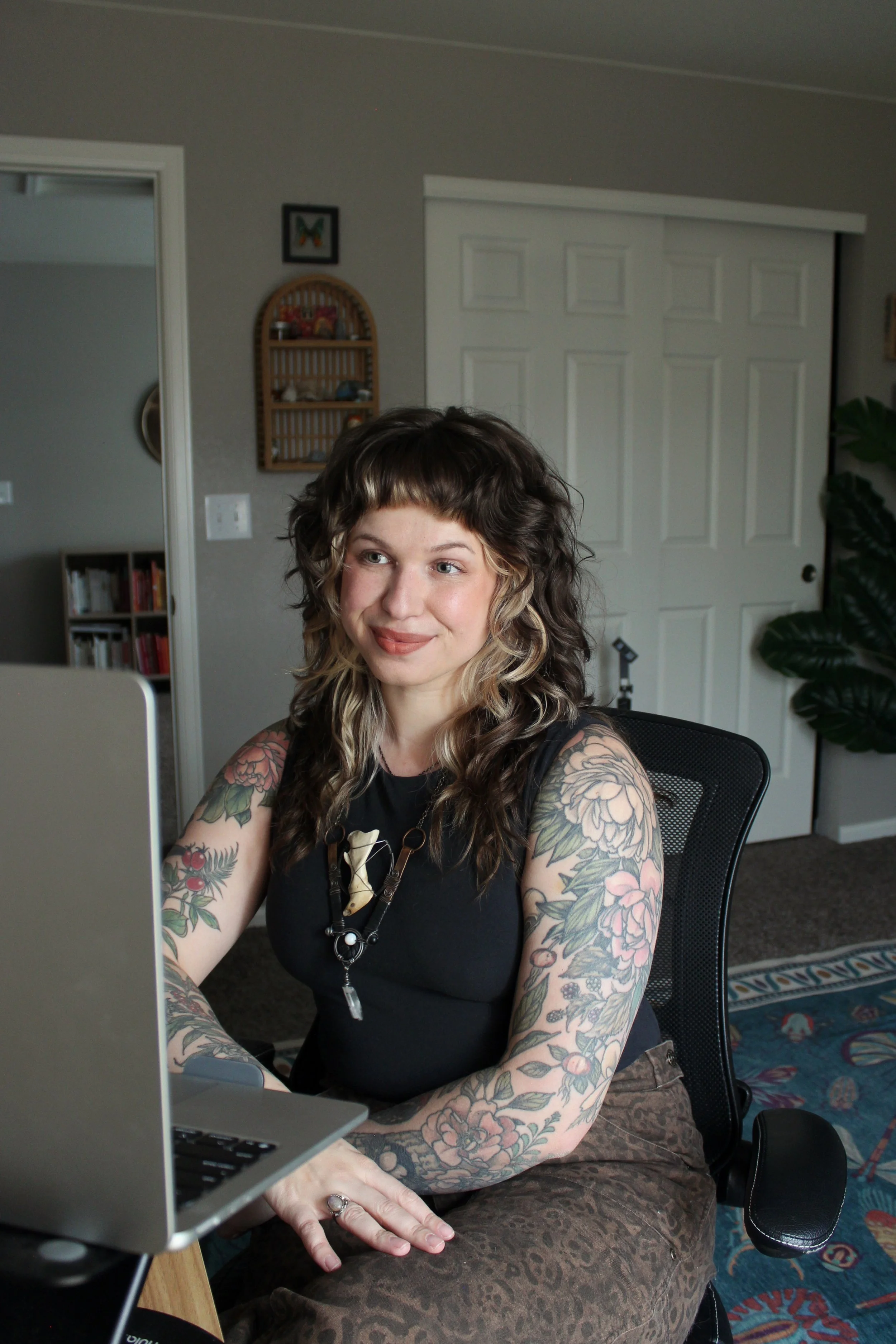




Here’s what to expect during your online therapy sessions:
I’ll join our video session with a minimum of 2 drinks in hand (one Stanley full of ice water and a mug of whatever herbal tea I’m currently obsessed with).
Instead of leaving you wondering what we’re going to talk about, if you’ll have enough to say, and if you can *really* share about the things you said, did, or believed to fit into your former religious community or spiritual group, we’ll start every session with a recap of the previous one and mapping out what we’ll be getting into next. You don’t have to worry about doing therapy “wrong” here.
My service dog (Odin) will likely make a cameo during our session too (and if you hear him snoring…sorry in advance).
How Somatic Online Therapy for Religious and Spiritual Trauma Breaks the Cycle
High-control environments leave footprints in both your thought patterns and your physical body. Because analytical minds are so skilled at talking around trauma, simply discussing your past isn't always enough to help your body feel safe.
We weave somatic and brain-body modalities into our sessions to bridge that gap. You get the tools to release stored survival responses directly from your nervous system so you don’t need to put pressure on yourself to have the perfect words to describe your experiences.
Brainspotting Helps You Bypass the Urge to “Perform” in Therapy
If you tend to overthink and overanalyze, you might put pressure on yourself to “perform” or be do therapy the “right” way. Brainspotting helps interrupt that urge by working directly with the brain-body connection.
We’ll work together to identify specific visual points that are linked to physical activation you experience when old religious or spiritual topics surface. Holding your gaze on these spots gives your subcortical brain space to process residual stress at its own natural pace.
Optional Spiritual Exploration
As someone who navigated my own exit from Catholicism and steered clear of high-control alternative spiritual spaces afterward, I understand the fear of inadvertently trading one rigid worldview for another.
If you choose to explore or reconstruct a spiritual path, we’ll work collaboratively to protect your critical thinking so you don't slip into those old survival strategies or feel like you have to give your autonomy up again.
Whether your journey leads you to a secular existence, comfortable agnosticism, or a decolonized spiritual practice, your autonomy remains the top priority.
Internal Family Systems (aka Parts Work) to Make Peace with Your Old Survival Tactics
When you’re used to belonging riding on strict compliance, your system learns to adapt through extreme coping strategies like perfectionism, chronic people-pleasing, and constant overthinking to avoid being rejected.
Parts Work gives us a way to approach these patterns with curiosity instead of self-judgment. Rather than fighting your inner critic or trying to force away your anxiety, we recognize these behaviors for what they always were: loyal internal bodyguards that worked overtime to keep you safe in an unsafe environment.
Together, we’ll help these protective parts realize that the emergency is over.

Here’s what one of my colleagues wants you to know about me
“Halle is a phenomenal therapist & human. She is so approachable & genuine, and provides trauma-informed care that is sensitively attuned to marginalized communities (BIPOC, queer, neurodivergent, chronically ill folks). I wholeheartedly recommend her work.”
-Liz Zhou, LPC
Therapy for Religious Trauma and Spiritual Abuse can help you:

…of leaving, of losing your community, and of realizing just how much harm you endured.
…and your reality. You know what you experienced wasn’t okay and you’re allowed to acknowledge that.

…and see how much better life feels when you’re not constantly worried about being punished.

Another colleague thinks this is important for you to know too
“I highly recommend Halle for anxiety and trauma therapy. Her affirming, culturally responsive approach supports clients navigating identity, family expectations, and burnout while building confidence, boundaries, & lasting emotional resiliency.”
– Ann Robinson, LCSW

Your Investment
$250 per session
Paid at the time of each session using your HSA/FSA, credit/debit card.
A note on self-pay therapy:
Paying for therapy directly affords you more privacy and more choices for how you get support with your anxiety.
Instead of being given a mandatory diagnosis and cut off after the 10 sessions your insurance is willing to approve, self-pay therapy allows you to better understand yourself on (and in!) your own terms.

Weekly sessions create the link between what you understand logically and what you experience somatically.
You’re likely brilliant at mapping out the systemic flaws of high-control spaces and voicing how they affected you. Unfortunately, knowing the mechanics behind the harm doesn't always calm the shallow breathing, racing pulse, or sudden surge of panic when old triggers get pulled.
Our weekly sessions provide space for your nervous system to catch up to the physical reality that you’re safe and that you never have to shrink yourself again to satisfy rules built on fear, shame, and obedience.
FAQs About Therapy for Religious Trauma in Oregon
-
First things first, I’m so sorry that you’ve experienced harm in therapy.
I’ve worked with many folks who’ve had bad experiences with therapists, from noticing the therapist was highly distracted, to the therapist mimicking tactics used in their former religious or spiritual group.
If you want to try therapy again and decide to try working with me, you should know that I’m not here to tell you how to live your life (because I don’t actually know what will be best for you).
-
I know this might be tough to hear, but I fully believe you’ll be much better supported by working with a therapist you can afford to see weekly.
Weekly therapy tends to work best for the kind of anxiety I treat, especially when you’ve spent years stuck in overthinking, self-doubt, and trying to manage everyone else’s expectations.
And because I want you to have the best outcomes in therapy, I’d rather encourage you to find a therapist you can afford to see consistently than put you in a situation that adds more pressure to your life.
-
Yes, I can provide a superbill for you to submit to your insurance for possible out-of-network reimbursement. If you have PPO benefits, your plan may reimburse a portion of the cost (usually between 20%-80%).
Because a superbill is a medical document, it does require me to include a diagnosis. We can talk through that together so you understand what that means and can make an informed decision.
A lot of clients choose private pay therapy because it gives them more privacy and more flexibility in the kind of work we do, rather than having treatment shaped by what insurance is willing to cover.
-
I’ve supported people who’ve been involved with the following:
Catholicism
Evangelicalism
Seventh-Day Adventists
Jehovah’s Witnesses
Church of Jesus Christ of Latter Day Saints
Scientology
I also have experience supporting folks who’ve experienced spiritual abuse in online New Age communities or from self-proclaimed spiritual leaders/teachers/guides.
-
Then you don’t have to (it really is as simple as that). While my work can include supporting folks with decolonizing and reclaiming spiritual practices, it’s never required. Therapy is about supporting you with what you want for your life.
Reclaiming your life starts with a single, low-pressure step
Reaching the end of a page like this often triggers two feelings at once:
Validation that your body’s reactions aren't all in your head, and that familiar discomfort that comes with looking directly at old harm. If you’d like to explore virtual therapy for religious trauma and spiritual abuse, book a consultation call. It’s a zero-pressure conversation where you can ask whatever you need to, evaluate my approach, and decide if you’d like to start with weekly therapy or a therapy intensive. If you’re not quite ready to address the trauma you’ve experienced, but still want to work together, you might prefer to start with anxiety therapy instead.