

Online Anxiety Therapy in Longmont, Colorado
Culturally affirming anxiety therapy in Longmont & Boulder for overthinkers tired of neglecting their own needs just to keep the peace.
While all sessions are held virtually via a secure video platform, my practice is deeply rooted in supporting the communities of Longmont, CO, and Boulder, CO. You don't have to battle traffic on I-25 to get culturally affirming, anxiety therapy.
*Online anxiety therapy is available across the state of Colorado.


It’s time to break the cycles that led to your high-functioning anxiety.
While you won’t find high-functioning anxiety listed in the DSM, it’s the type of anxiety that stems from being prepared, productive, and accommodating in order to avoid criticism, rejection, or disappointing the people around you.
High-functioning anxiety like this often gets missed in women, BIPOC folks, LGBTQ+ folks, and men who’ve been taught that their only worth is tied to what they can do for others.
Working with a licensed anxiety therapist helps you stop internalizing your stress, examine the rules you’ve been living by, decide which ones no longer fit, and stop attaching your worth to your performance alone.
Internally, your high-functioning anxiety manifests in…
-

Feeling guilty every time you want something your family wouldn’t understand
-
Second-guessing whether a decision is actually right for you vs what's expected of you
-
Replaying conversations long after they're over (especially in the shower)
-
Feeling like you’re performing your life instead of living it
-
Carrying the pressure to be the responsible one, the good one, or the successful one
-
Questioning who you really are and what you actually like

You're not broken. You’ve just spent a long time trying to be who other people expected you to be, which is a common experience for BIPOC and LGBTQ+ folks living in Longmont or Boulder.
You may have learned that being “good” meant being selfless, successful, loyal, or easy to accommodate. So now, even when something doesn’t feel right, you still question yourself before you question the pressure around you.
So of course that’s left you stuck in overthinking, guilt, and the constant fear of getting it wrong (and what it might cost you if you do).
Culturally affirming anxiety therapy provides a space to slow that down so you can understand the beliefs, roles, and expectations that shaped you, so you can build a steadier, more grounded relationship with yourself.
How to Start Online Anxiety Therapy in Longmont or Boulder
-

Book Your Consult
We’ll chat for 15 minutes about your goals and my expertise to see if it makes sense to book a first session.
-

Your First Session
In our first session, we’ll start making sense of why you feel so stuck between your own needs and everyone else’s expectations.
-

Get a Custom Plan
Based on our initial session, I’ll present you with a roadmap for how we’ll address your anxiety.
-

Work Through It
We’ll meet at the same time each week and start practicing new techniques to reduce your anxiety.
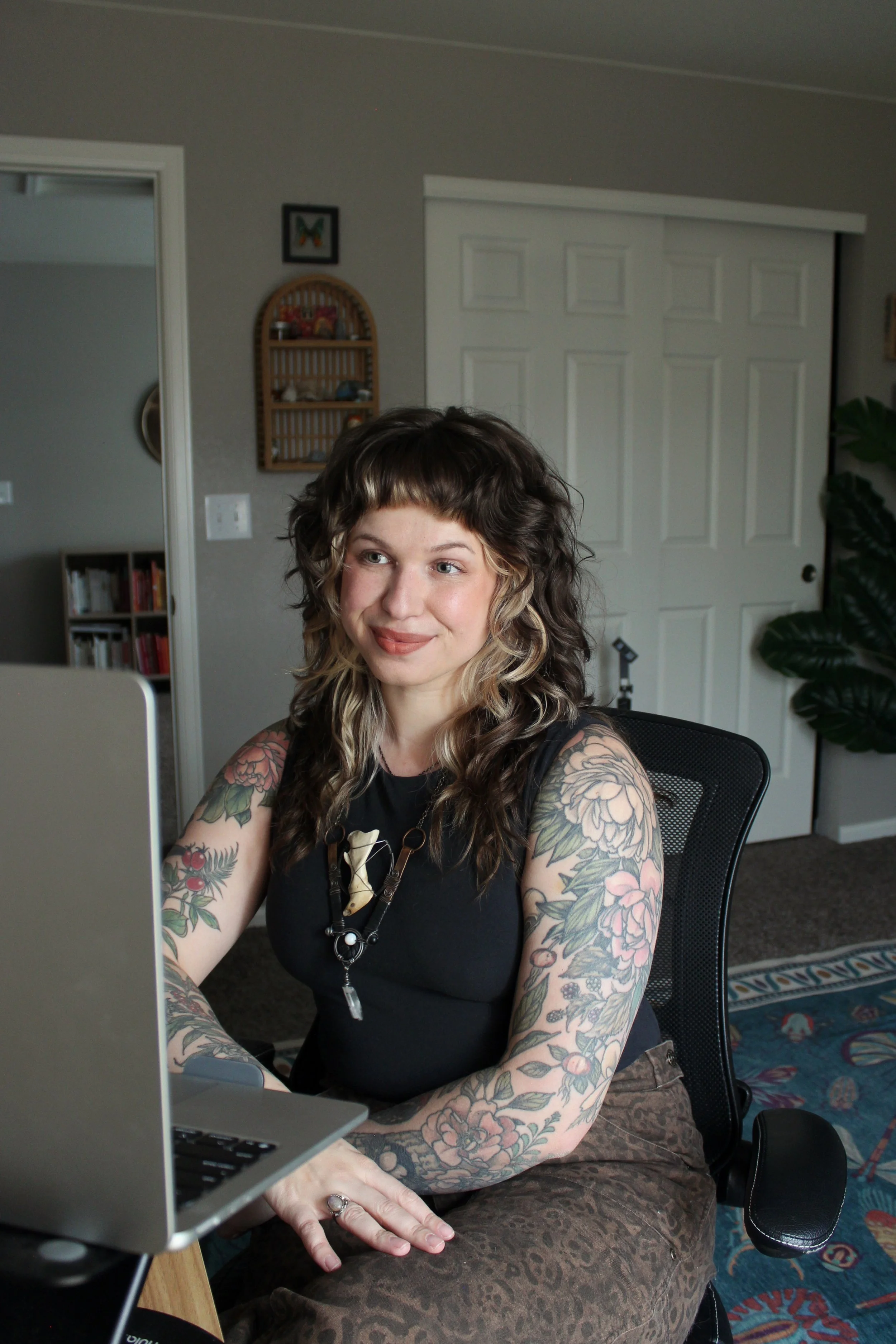




Here’s what to expect during your online anxiety therapy sessions:
I’ll join our video session with a minimum of 2 drinks in hand (one Stanley full of ice water and a mug of whatever herbal tea I’m currently obsessed with).
Instead of leaving you wondering what we’re going to talk about, if you’ll have enough to talk about, and if you can *really* share about your recurring stress dream, we’ll start every session with a recap of the previous one and set an agenda for what we’ll be getting into next.
My service dog (Odin) will likely make a cameo during our session too (and if you hear him snoring…sorry in advance).
My Approach to Online Anxiety Therapy in Longmont and Boulder
Anxiety lives in the body and the mind, which is exactly why I use approaches that go deeper than just talking about your problems.
Internal Family Systems (aka Parts Work) for Increased Self-Compassion
If you’re constantly exhausted from hiding your stress and struggles from everyone around you, it’s usually because a specific part of you has taken on the full-time job of keeping you safe by being perfect, productive, or overly accommodating. In our sessions, Parts Work helps us examine and adjust these internal dynamics.
Instead of viewing your anxiety as a character flaw you need to eliminate, IFS looks at anxiety as a protective mechanism. You might have an "anxious overthinker part" that stays up until 2:00 AM trying to predict every possible disaster, a "perfectionist part" that views a minor mistake as an existential threat, and even a "people-pleasing part" that carries immense guilt whenever you try to set a boundary.
By learning to approach these different parts of yourself with curiosity rather than frustration, we can understand the old rules they’ve been living by, separate them from inherited family expectations, and finally lead your life with genuine self-compassion instead of constant performance.
Brainspotting for Anxiety Regulation
Brainspotting therapy operates on the neurobiological understanding that where you look affects how you feel. By using specific eye positions, we bypass the thinking loops and access the subcortical brain, which is the deeper, non-verbal region where anxiety, survival mechanisms, and physical trauma responses are stored.
Working at the nervous system level gives your body the physical space it needs to process and release deep-seated tension, finally allowing your physical state to catch up with your intellect. It’s an incredibly efficient tool for getting actual, somatic relief without needing to talk in circles for months.
Spirituality-Informed Practices
If part of your experience has included leaving the religion you were raised in and and you want to reclaim your spirituality on your own terms, we can co-create a safe space to explore exactly what that looks like. Not only can we talk about the hurt you might have experienced in a dogmatic religion, but we can talk about what it looks like to decolonize your relationship to your own spirituality.

Here’s what one of my colleagues wants you to know about me
“Halle’s integration of non-traditional modalities allows for deeper processing and meaningful healing, particularly for those navigating high-pressure environments where slowing down can feel impossible. I highly recommend working with her.”
– Sarah Rincon, LPC
Weekly anxiety therapy sessions teach you to:

…to your own preferences without spiraling into shame, existential dread, or guilt.

…without feeling guilty for the ways they’re different from what your family expects them to be.

…which beliefs are yours, and which were handed to you from your family or religious upbringing.

Another colleague thinks this is important for you to know too
“Halle is like a breath of fresh air for those experiencing anxiety. In a tornado of intrusive thoughts, fear, shame, and doubt, she is a steady hand and a reassuring voice encouraging you on.”
– Lauren Puliz, LMFT

Your Investment
$250 per session
Paid at the time of each session using your HSA/FSA, credit/debit card.
A note on self-pay therapy:
Paying for therapy directly affords you more privacy and more choices for how you get support with your anxiety.
Instead of being given a mandatory diagnosis and cut off after the 10 sessions your insurance is willing to approve, self-pay therapy allows you to better understand yourself on (and in!) your own terms.


With weekly therapy, we lean on Brainspotting and parts work, along with your cultural and spiritual practices to get actual relief from anxiety.
As an overthinker, you’re incredibly self-aware (and maybe even too self-aware). And while you can explain why you feel anxious, it doesn’t make the feeling go away. That’s why we use Brainspotting to move past the talking and into the root of your emotional blocks and physical tension. By working with your anxiety at the nervous system level, we’ll give your body the space it needs to finally catch up with your brain's ability to heal.
FAQs About Anxiety Therapy in Longmont & Boulder
-
If your last experience in therapy didn’t help, it doesn’t mean you’re beyond help or that therapy “doesn’t work” for you. A lot of my clients have tried therapy before and left feeling like they spent a lot of time talking about their week without actually making any progress.
That’s especially common if your anxiety shows up as overthinking, guilt, people-pleasing, or constantly second-guessing yourself. On the outside, you may look high-functioning, but on the inside you’re exhausted from trying to get every decision “right” and from carrying the pressure to be the responsible one.
My approach is more structured than generic talk therapy. We track what’s keeping you stuck, work with the deeper patterns underneath the anxiety, and help you build more trust in yourself over time.
-
I know this might be tough to hear, but I fully believe you’ll be much better supported by working with a therapist you can afford to see weekly.
Weekly therapy tends to work best for the kind of anxiety I treat, especially when you’ve spent years stuck in overthinking, self-doubt, and trying to manage everyone else’s expectations.
And because I want you to have the best outcomes in therapy, I’d rather encourage you to find a therapist you can afford to see consistently than put you in a situation that adds more pressure to your life.
-
Yes, I can provide a superbill for you to submit to your insurance for possible out-of-network reimbursement. If you have PPO benefits, your plan may reimburse a portion of the cost (usually between 20%-80%).
Because a superbill is a medical document, it does require me to include a diagnosis. We can talk through that together so you understand what that means and can make an informed decision.
A lot of clients choose private pay therapy because it gives them more privacy and more flexibility in the kind of work we do, rather than having treatment shaped by what insurance is willing to cover.
-
Most clients meet with me weekly for Anxiety Therapy for about 4-12 months.
Most clients in weekly therapy work with me for around 4–12 months.
That said, the timeline depends on what you’re carrying. If your anxiety is tied to deeper patterns like guilt, family pressure, self-abandonment, or always feeling responsible for everyone else, this usually is not something that shifts overnight.
If you know you want to work more quickly or for a shorter amount of time, I recommend a Brainspotting Intensive.
-
If anxiety is affecting your sleep, your relationships, your ability to make decisions, or your enjoyment of everyday life, it's serious enough to get support.
You don't have to be having panic attacks in a grocery store parking lot to "qualify" for therapy.
A lot of the people I work with look totally fine from the outside. They're hitting their deadlines, showing up for everyone in their life, and keeping it all together. Internally though? They’re running on fumes and self-doubt.
If you're exhausted from managing it alone, that's enough of a reason to reach out. -
Yes! This is one of the main things I help clients with.
A lot of my clients aren’t struggling with general anxiety, but anxiety that’s specific to their obligations. They feel deeply torn between loyalty to the people and systems that shaped them and the growing awareness that they want something different for themselves.
Therapy can help you sort through that conflict without reducing it to “just set boundaries” or “just stop caring what people think.”
Therapy can help you understand what’s actually yours, what was handed to you, and how to make decisions with more clarity and less fear about other people’s reactions to those decisions. -
That’s okay! Not knowing what you want is often a sign that you’ve spent a long time focused on what other people needed, expected, or approved of.
In therapy, we slow that process down so you can get clearer on your preferences, values, needs, and desires without judging yourself for having them.
You don’t need to come in with everything figured out. I’ll be there to help you connect to yourself so you can identify exactly what you want.
It’s time for you to live your life on your terms.
If you've made it this far, you might have a bit of a pit in your stomach because feeling even a sliver of hope about your anxiety getting better feels scary.
And while that might sound strange to other people, being afraid of hope makes complete sense to me. The good news? You can bring the fear with you to a consultation call and and I’ll give you all the information you need to feel more settled before starting anxiety therapy with me here in Longmont, Boulder, or elsewhere in the state of Colorado.