
Online RELIGIOUS TRAUMA Therapy IN Denver, COLORADO
For those who’ve physically left their church, but still feel mentally trapped in the pews.
The effects of religious trauma and spiritual abuse can linger long after you’ve left. A even after you’ve deconstructed, you sometimes find yourself thinking in line with the old rules you consciously rejected. This leaves your mind looping in circles while your body locks up with anxiety or guilt.
Through body-based therapies like Brainspotting and parts work, you’ll learn to identify where outdated messaging from those communities is overriding your actual needs, wants, and desires so you can live life on your own terms.

Why Is Religious Deconstruction So Challenging?
Intellectually, you know it’s not your fault that your church or spiritual community hurt you. Your nervous system just hasn’t received the memo yet.
You don't need a therapist to tell you that high-control religious and spiritual spaces cause deep harm when you’ve lived it yourself. What you need a therapist for though, is help with the emotional cleanup after you’ve left that environment.
While you’ve been doing your own work to deconstruct, you might feel anxious about how intensely your body is resisting the very freedom your mind has chosen. Your chest tightens when you even think about voicing a boundary, and you still dread the risk of facing eternal punishment. These are physical reminders that you were trained to hand over your autonomy in exchange for the illusion of acceptance.
Common Signs of Religious Trauma in High-Functioning Overthinkers
-

Feeling angry that your former religious and spiritual leaders lied to you
-
Experiencing anxiety and fear about doing (or thinking) the wrong things
-
Grieving the loss of your community and built-in support network
-
Shaming yourself for your gender identity, sexual orientation, and even your racial identity
-
Guilt-tripping yourself for “betraying” your family and culture by leaving
-
Wanting to reclaim your spirituality, but feeling afraid you’ll get hurt again

Therapy for Religious Trauma Helps You Deconstruct So You Can Reclaim Your Autonomy
High-control communities demand unquestioning loyalty. Now, it’s time to be loyal to yourself.
When you’re taught from day one that you’re inherently broken, your default survival strategy is to become small, compliant, and hypervigilant. You did whatever it took to be seen as "good" by the people you trusted, even if it meant overriding your own boundaries (if you were allowed to have boundaries at all).
It’s exhausting to realize that while you’ve intellectually moved on, your body is still holding onto the anxiety, anger, and confusion left behind by their rules.
In therapy, we don’t just rehash the doctrine you were exposed to. Using Brainspotting and Parts Work, you’ll learn how to continue your deconstruction, decolonize and reclaim any spiritual practices you want to keep, and cut ties with the harmful religious and spiritual messaging that keeps rattling around in your head.
100% Virtual Therapy for Adults in Denver and All of Colorado
How to Start Religious Trauma Therapy in Denver
-

Book Your Consult
We’ll chat for 15 minutes about your goals and my expertise to see if it makes sense to book a first session.
-

Your First Session
We’ll look at how religious trauma shows up in your day-to-day life and start imagining what you want your future to be like.
-

Get a Custom Plan
Based on our initial session, I’ll present you with a roadmap for how we’ll address the aftermath of religious trauma.
-

Rewire & Reclaim
We’ll meet at the same time each week and process the trauma so you can reclaim your autonomy.
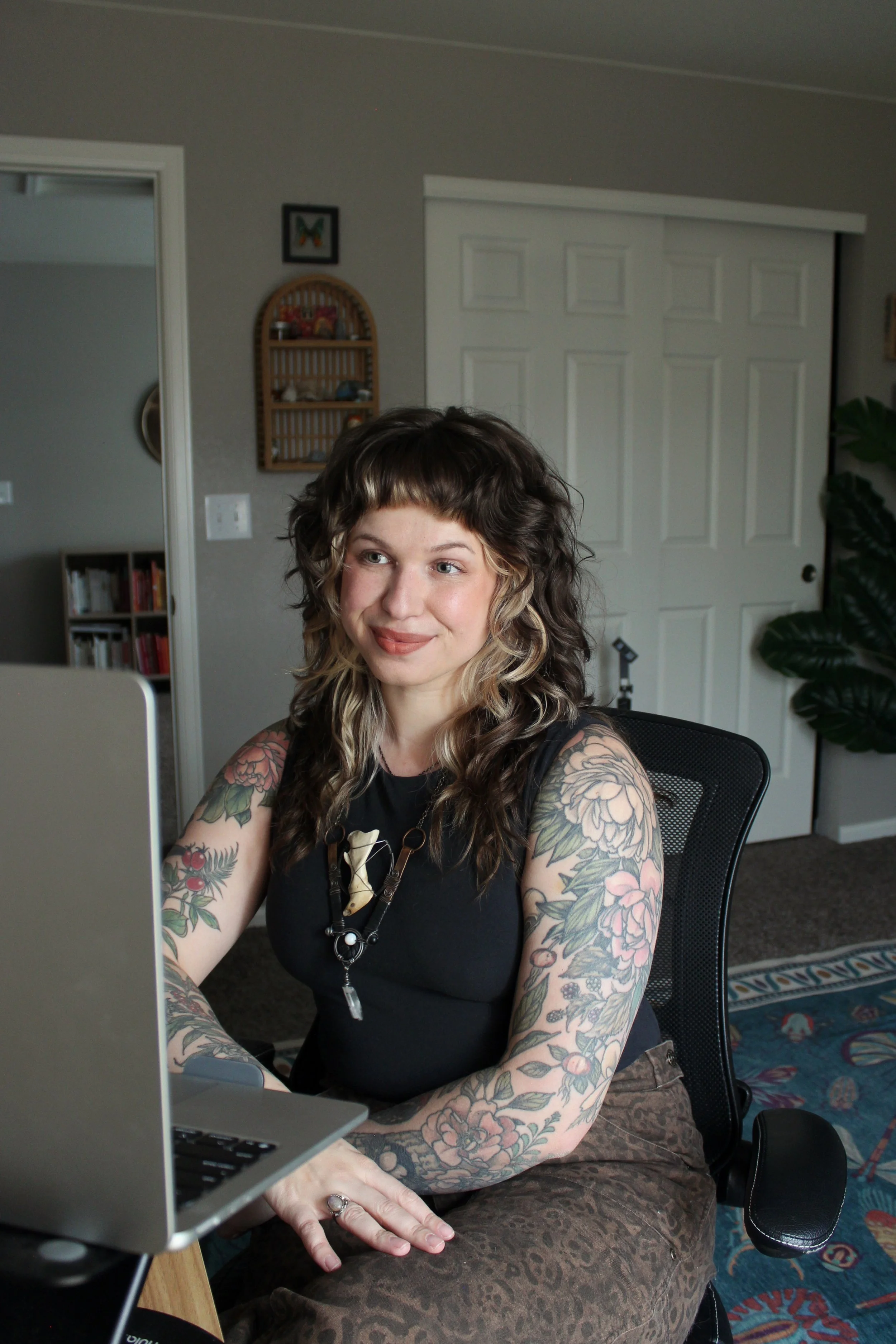




Here’s what to expect during your online therapy sessions:
I’ll join our video session with a minimum of 2 drinks in hand (one Stanley full of ice water and a mug of whatever herbal tea I’m currently obsessed with).
Instead of leaving you wondering what we’re going to talk about, if you’ll have enough to say, and if you can *really* share about the things you said, did, or believed to fit into your former religious community or spiritual group, we’ll start every session with a recap of the previous one and mapping out what we’ll be getting into next. You don’t have to worry about doing therapy “wrong” here.
My service dog (Odin) will likely make a cameo during our session too (and if you hear him snoring…sorry in advance).
My Approach to Online Therapy for Religious Trauma and Spiritual Abuse
The aftermath of leaving a high-control group can be noticed both in the way you think, and in the physical sensations you feel in your body. My practice goes beyond standard talk therapy. By integrating deep somatic and brain-body modalities you have the opportunity to process your experiences without having to find the perfect words for them.
Brainspotting for Non-Verbally Processing Trauma
If you’re an overthinker, you might put pressure on yourself to perform in therapy or otherwise “win” the session. Instead of relying on talking alone, Brainspotting is a tool that acknowledges the simple reality that where you look affects how you feel.
Spiritual Exploration That’s 100% Optional
As an ex-Catholic and someone who narrowly avoided some New Religious Movements shortly after leaving the Catholic Church, I know how challenging it can feel to reclaim your spiritual life.
If you want spirituality to remain part of your life, but you’re terrified of slipping into autopilot and performing a new set of dogmas, we’ll work together to prevent that from happening.
Whether your path leads to a decolonized and reconstructed spiritual life or a completely secular, but grounded existence, your agency and autonomy are the most important things here. We make sure that whatever you choose to hold onto actually feels safe to your nervous system, completely free from pressure, guilt, or the need for another leader, guide, or guru.
Internal Family Systems (aka Parts Work) for Self-Understanding
In high-control environments, you were expected to be perfect, hyper-productive, or overly accommodating to stay safe. In our sessions, we’ll use Parts Work not to judge these habits, but to understand why they developed in the first place.
This gives us a chance to view these parts as different protectors who did what they could to help you (and others) survive. Then, we’ll work together to gives these parts some new job descriptions so they don’t continue to see threats where they no longer exist.

Here’s what one of my colleagues wants you to know about me
“Halle really knows how to create a space where you can move through self-doubt and start stepping into a version of healing that feels real, grounded, and actually possible. ”
– Geri Lopez, LPC
Therapy for Religious Trauma and Spiritual Abuse Helps You:

…of leaving, of losing your community, and of realizing just how much harm you endured.

…and your reality. You know what you experienced wasn’t okay and you’re allowed to acknowledge that.

…and see how much better life feels when you’re not constantly worried about being punished.

Another colleague thinks this is important for you to know too
“Halle brings a unique blend of warmth and depth, helping clients work at the nervous system level to create real, lasting change. You feel supported, understood, and more connected to yourself in the process.”
– Sarah St. Martin, LCSW, RYT

Your Investment
$250 per session
Paid at the time of each session using your HSA/FSA, credit/debit card.
A note on self-pay therapy:
Paying for therapy directly affords you more privacy and more choices for how you get support with your anxiety.
Instead of being given a mandatory diagnosis and cut off after the 10 sessions your insurance is willing to approve, self-pay therapy allows you to better understand yourself on (and in!) your own terms.

Weekly somatic therapy bridges the gap between what your mind knows and what your body feels.
You’re likely able to dissect the dynamics of your former high-control group perfectly and articulate exactly why certain dogmas were harmful. But knowing why they caused so much damage doesn’t always stop the chest tightening, stomach flipping, and eye watering that happens when you get caught up in a memory.
Our weekly sessions provide space for your mind and body to recognize that you’re safer than you’ve ever been and that you have the freedom to no longer live by rules that were used to keep you small, compliant, and afraid.
FAQs About Therapy for Religious Trauma in Longmont, Boulder, Denver and Across Colorado
-
First things first, I’m so sorry that you’ve experienced harm in therapy.
I’ve worked with many folks who’ve had bad experiences with therapists, from noticing the therapist was highly distracted, to the therapist mimicking tactics used in their former religious or spiritual group.
If you want to try therapy again and decide to try working with me, you should know that I’m not here to tell you how to live your life (because I don’t actually know what will be best for you).
-
I know this might be tough to hear, but I fully believe you’ll be much better supported by working with a therapist you can afford to see weekly.
Weekly therapy tends to work best for the kind of anxiety I treat, especially when you’ve spent years stuck in overthinking, self-doubt, and trying to manage everyone else’s expectations.
And because I want you to have the best outcomes in therapy, I’d rather encourage you to find a therapist you can afford to see consistently than put you in a situation that adds more pressure to your life.
-
Yes, I can provide a superbill for you to submit to your insurance for possible out-of-network reimbursement. If you have PPO benefits, your plan may reimburse a portion of the cost (usually between 20%-80%).
Because a superbill is a medical document, it does require me to include a diagnosis. We can talk through that together so you understand what that means and can make an informed decision.
A lot of clients choose private pay therapy because it gives them more privacy and more flexibility in the kind of work we do, rather than having treatment shaped by what insurance is willing to cover.
-
I’ve supported people who’ve been involved with the following:
Catholicism
Evangelicalism
Seventh-Day Adventists
Jehovah’s Witnesses
Church of Jesus Christ of Latter Day Saints
Scientology
I also have experience supporting folks who’ve experienced spiritual abuse in online New Age communities or from self-proclaimed spiritual leaders/teachers/guides.
-
Then you don’t have to (it really is as simple as that). While my work can include supporting folks with decolonizing and reclaiming spiritual practices, it’s never required. Therapy is about supporting you with what you want for your life.
It’s time for you to live your life on your terms.
If you've read to the bottom of this page, you might be feeling a strange mix of validation and discomfort.
Validation because another person is acknowledging just how bad it all was and discomfort because, well, it really was that bad. If you want to talk about starting therapy and working through the religious trauma and spiritual abuse you’ve experienced, you’re invited to book a free consultation call. This is a no-pressure call where you’ll have time to ask questions about therapy to see if it make sense for us to schedule a first session.